


Transportation, mobility, and access

Transportation policy is housing policy, labor policy, air-quality policy, and disability policy. The way we design movement through our communities determines who has access to opportunity and who gets left behind.
Infrastructure should be designed around people, not just cars or political ribbon-cuttings. Good infrastructure expands freedom. It determines whether someone can get to work, whether a senior can reach a grocery store, whether a person with a disability can navigate their own neighborhood, and whether families are spending their income building a better life or simply paying the rising cost of getting around.
One of the people who has long inspired me in this space is Walt Disney— not just as a storyteller, but as a planner and builder. He had the ability to dream beyond what seemed possible and then work to make it real. His idea of imagineering— pairing imagination with engineering— was ultimately about designing complete systems for how people live. Transportation, housing, energy, shopping, public space, and the daily necessities of life all had to work together. That kind of long-range master planning matters because communities do not function well when every part is designed in isolation.
I call this Smart Density. It is not a zoning category— it is a planning philosophy.
Smart Density means more homes, more transit, and more daily necessities designed to work together instead of fighting each other for space. It means building housing near transit, jobs, schools, parks, healthcare, and grocery stores—not building housing first and connecting it to nothing. It means recognizing that the conversation about where people live and the conversation about how people move are the same conversation, because in every functioning city in the world, they already are.
That is one of the central failures in how we often approach growth in Utah. Transportation, housing, infrastructure, and access to daily necessities are all interconnected. When we fail to plan them together, we create long commutes, rising household costs, worsening air quality, and neighborhoods where basic needs are miles away. We create food deserts where grocery stores are inaccessible without a car. We create communities where people are trapped by distance and car dependency.
That is not thoughtful growth. That is drift. And drift benefits somebody.
Car-dependent sprawl does not keep getting built by accident. It is often cheaper and faster for developers to skip transit connections, sidewalks, bike infrastructure, and nearby services, then leave the next homeowner, renter, worker, or driver to absorb the cost through commute time, fuel, insurance, maintenance, and car payments they cannot avoid. The people who benefit from car-dependent design are rarely the people stuck paying for it twice— once through higher housing costs and again through the cost of simply getting around.
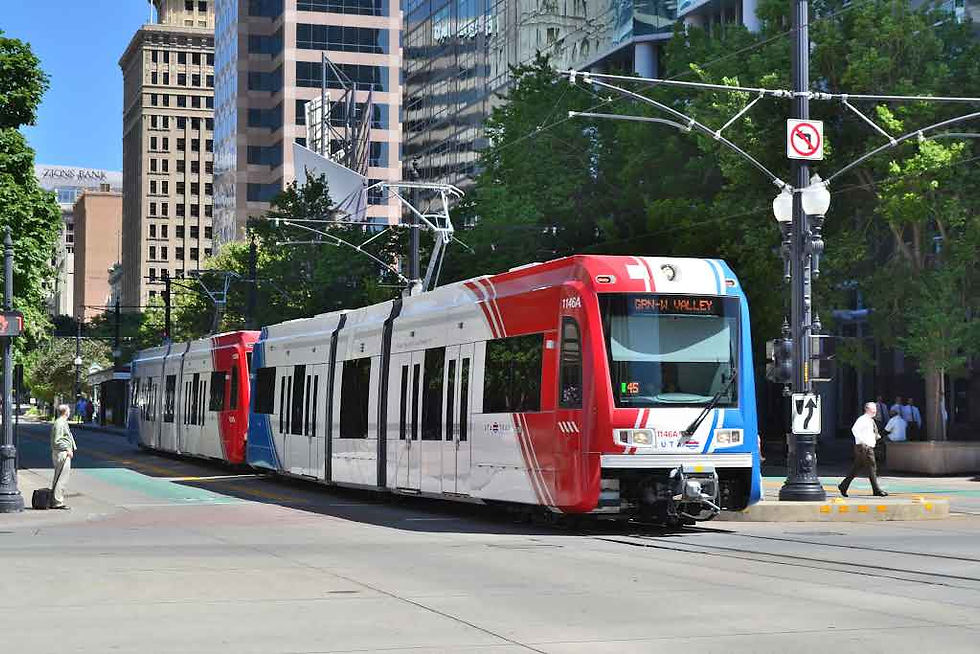
I support a major expansion of UTA, TRAX, and FrontRunner, including moving toward 24-hour service. We need to think about third shift. We need to think about overnight workers. Nurses, hospital staff, first responders, service workers, warehouse workers, hospitality workers, and countless others who keep Utah running long after midnight. Public transportation should work for them too.
A serious transit system does not shut down at midnight and barely function on weekends. If we want public transportation to be a real alternative, it has to be reliable, frequent, connected, and available when people actually need it. That means more routes, more lines, better frequency, and service hours that reflect the reality of modern life rather than an outdated nine-to-five model. None of this is free, and pretending otherwise is how good ideas die in committee.
Right now, transit expansion competes for general-fund dollars against nearly everything else the state already underfunds, while the growth driving the need for that expansion contributes almost nothing toward it. We are already making this mistake with our electric grid— allowing residential ratepayers to absorb the cost of grid buildout demanded by data centers. We cannot repeat it with transportation.
Growth should help pay for the infrastructure growth requires. That means transit-oriented development standards that connect new housing to transportation instead of isolating it. It means impact fees on sprawling development that creates new infrastructure demands while skipping meaningful transit connections. And it means treating transit expansion as core infrastructure funding— not as an optional line item that gets cut first whenever budgets tighten.
Right now, Utah’s Impact Fees Act does not clearly allow those fees to fund transit connectivity. That is a gap I intend to close by sponsoring legislation that expands what those fees can cover.
This is not just about convenience. Utah is on track to add another two million residents in the decades ahead. We do not have the infrastructure for every household to depend on two or three cars just to survive. That is not sustainable for our roads, our air quality, household budgets, or the long-term livability of this state.
Walkability, bike safety, and maintenance matter too, and they need real funding—not whatever remains after roads are funded first.
Utah already has an Active Transportation Investment Fund and a Transit Transportation Investment Fund on the books. Those are good steps, but they remain a sliver compared with the billions committed to roads every legislative session. If we can find bonding authority and one-time appropriations in the billions for highways, we can bring that same seriousness to the sidewalks, bike lanes, crossings, and trail connections people use every day.
That means adopting complete-streets standards requiring sidewalks, curb cuts, safe crossings, and protected bicycle infrastructure on every new and rebuilt road—not just those in wealthier districts. It means properly funding Safe Routes to School so children can walk or bike without their parents needing a second car just to manage drop-off and pickup.
And it means treating e-bikes and e-scooters as legitimate transportation options— particularly for folks who can no longer drive long distances and for workers whose commute is too far to walk but too short to justify the expense of another car.
Safe sidewalks, protected bike routes, reliable transit, and well-maintained streets are not extras. They are parts of a transportation system that gives people multiple ways to move through the world safely and independently.
Accessibility cannot be an afterthought bolted onto a transit map. Curb cuts that end in the middle of a block, sidewalks that disappear without warning, and bus stops with no safe path connecting them to the street are not minor design flaws. They can be the difference between a person with a disability having a life that belongs to them and being forced to depend on someone else’s schedule, availability, and car.
Paratransit must be reliable, not a same-day gamble. ADA compliance backlogs on sidewalks, crossings, and stations need to be funded and completed— not studied indefinitely. Accessibility should be incorporated from the beginning because retrofitting exclusion later is almost always more expensive and less effective.
If a transportation system only works for people who can walk quickly, see clearly, climb stairs, and drive whenever transit fails them, it was never actually designed for everyone. A society built on infinite diversity in infinite combinations needs multiple ways to move through the world.
The goal of transportation policy should not simply be moving cars faster. It should be connecting people to work, education, healthcare, food, family, recreation, and one another. It should be building communities where people can live, work, shop, and participate in public life in ways that are affordable, sustainable, accessible, and designed for the future ahead of us.
That is the kind of planning I believe in— the kind that helps us build a great big beautiful tomorrow on purpose instead of stumbling into a future we were too shortsighted to prepare for.


Comments